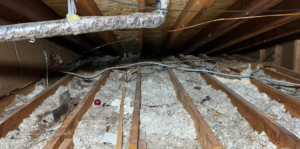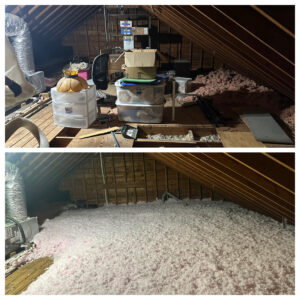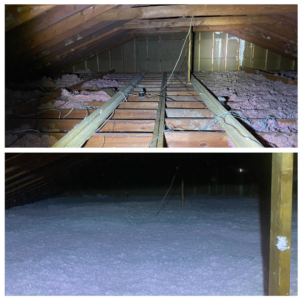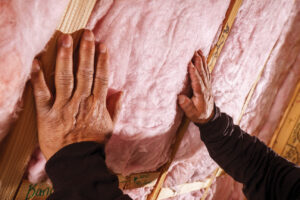
A vented attic has to breathe. Cooler, drier air should come in low at the soffits, move through the attic, and leave high at the ridge or another high vent. When that path is blocked or mixed up, heat and moisture sit under the roof, insulation gets shoved into the eaves, and the rooms below are harder to keep comfortable.
Many Virginia Beach and Hampton Roads homeowners still think of the attic as storage. Zhe Industries is a locally owned Virginia Class A contractor based in Virginia Beach. We do attic ventilation and soffit intake as part of attic insulation work, not as a roofing job. Our in-house crew calculates the vent area the attic needs, balances intake against exhaust, cuts in soffit intake where it is missing, and closes gable vents that are short-circuiting a ridge vent. That is the whole-house idea behind our tagline, “From the Rooftop to the Crawl, One Call!”: fix the building envelope, not just the insulation.
Why proper attic ventilation matters in Hampton Roads
Hampton Roads is a hot, humid climate. A poorly ventilated attic can run much hotter than the rooms below in summer, so the upstairs stays uncomfortable and the air conditioner works harder. In cooler, damp weather, moisture that cannot leave can wet the insulation and the roof deck. Insulation packed into the soffits cannot do its job in either season.
Common signs we see on Virginia Beach and Chesapeake homes include a much hotter second floor in summer, a musty attic, insulation stuffed into the eaves, and a ridge vent used together with gable vents. Proper attic ventilation does not replace insulation or air sealing. It lets those materials work the way they were designed to.
Intake and exhaust have to work together
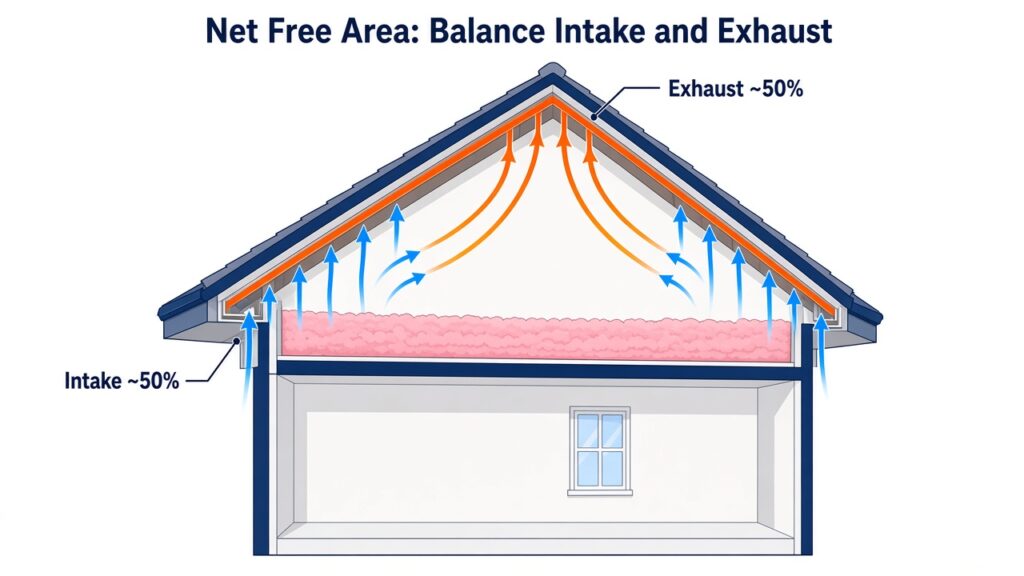
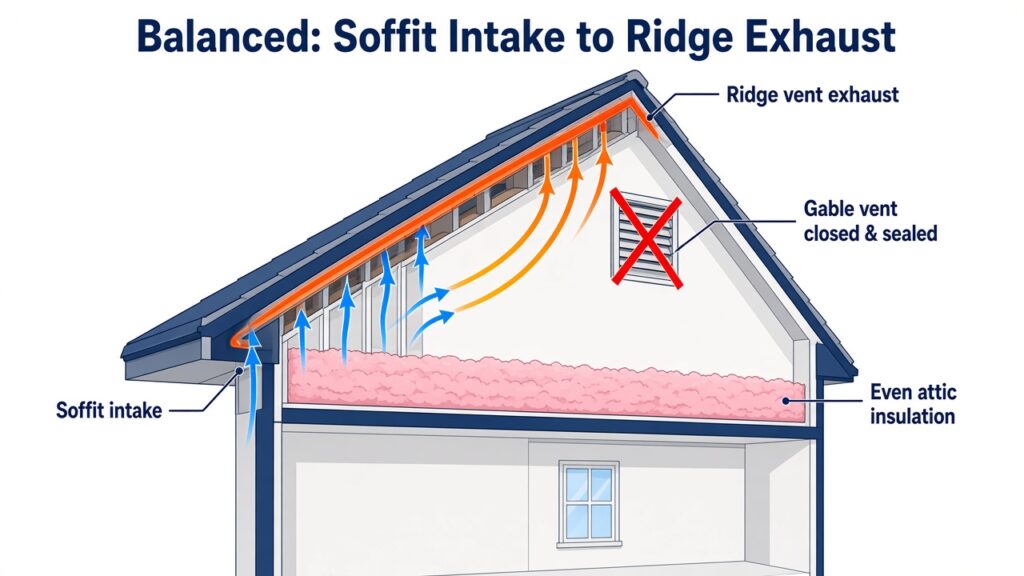
A balanced attic pulls roughly half of its ventilation area from low intake at the soffits and half from high exhaust, usually a ridge vent. Exhaust without enough intake cannot do its job. Extra exhaust, or a fan on top of blocked soffits, can pull air from the living space if the attic floor is leaky. Too much intake and too little exhaust leaves heat and humidity sitting under the roof.
The air has to travel the length of the attic, not take a shortcut near the peak. That is why the type of vents matters as much as the number of them. The full system, including soffit intake, is on our attic ventilation and soffit intake page.
When a ridge vent and gable vents short-circuit the attic
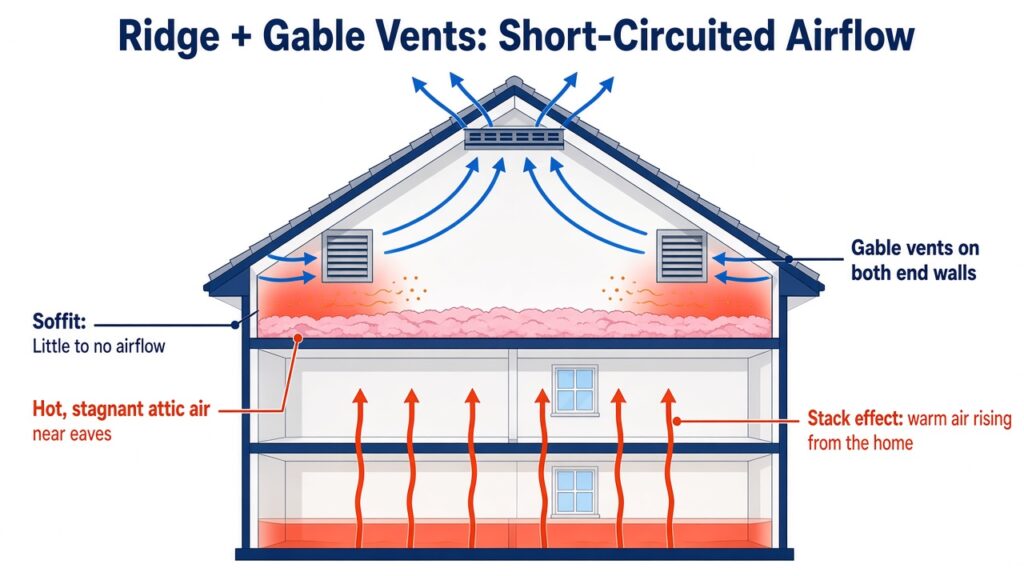
Many local homes have a ridge vent and gable vents on the same attic. Both are exhaust vents. Used together, the ridge often pulls air from the nearby gable openings instead of from the soffits, so the air takes a short path at the peak and skips the rest of the attic. Manufacturers call this short-circuiting and advise using one type of exhaust.
When we find that combination, our crew closes the gable vents from the attic side and cuts in soffit intake so the ridge can pull air from the eaves, through the attic, and out the peak. The gable louver can stay on the outside if you want the look. See when a ridge vent and gable vents fight each other.
Soffit intake is the half most homes are missing
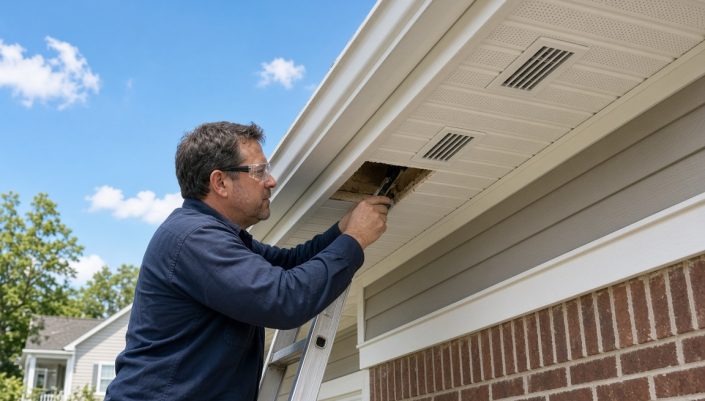
Soffit vents are the intake half of a balanced system. They sit on the underside of the eaves and let outdoor air into the lowest part of the attic. Many houses here have solid soffits, too few vents, or vents covered by old insulation or paint. When intake is short, our in-house crew cuts in soffit intake vents in the correct rafter bays so air can actually reach the attic.
This is soffit intake for ventilation, not a soffit-and-fascia replacement and not gutter work. If the wood is rotten or a whole soffit run needs to be replaced, we will say so.
Baffles belong in the same step. We install them in the rafter bays at the eaves so blown-in insulation cannot spill into the soffit or choke the intake.
How we calculate and balance the vent area
Net free area, or NFA, is the actual open area of a vent after the screen or slats are subtracted, not the size of the hole in the soffit. We add up the NFA of the intake and the exhaust that will remain, then size the new soffit vents — and, when needed, the exhaust our experienced roofing partner will install — so the attic has enough opening and a balanced split.
The Virginia Residential Code sets a minimum net free area for a vented attic, with a lower minimum when high and low vents are split the way the code describes. We size the work from the attic in front of us. The longer walkthrough is on the attic ventilation hub.
How ventilation fits with insulation and air sealing
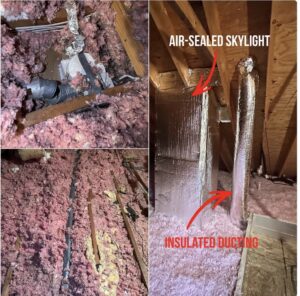
Ventilate the attic. Air seal the attic floor. Those are two different planes, and they have to be planned together. If the hatch, recessed lights, plumbing stacks, and top plates are still leaky, a well-vented attic can pull house air into the attic and waste the new insulation.
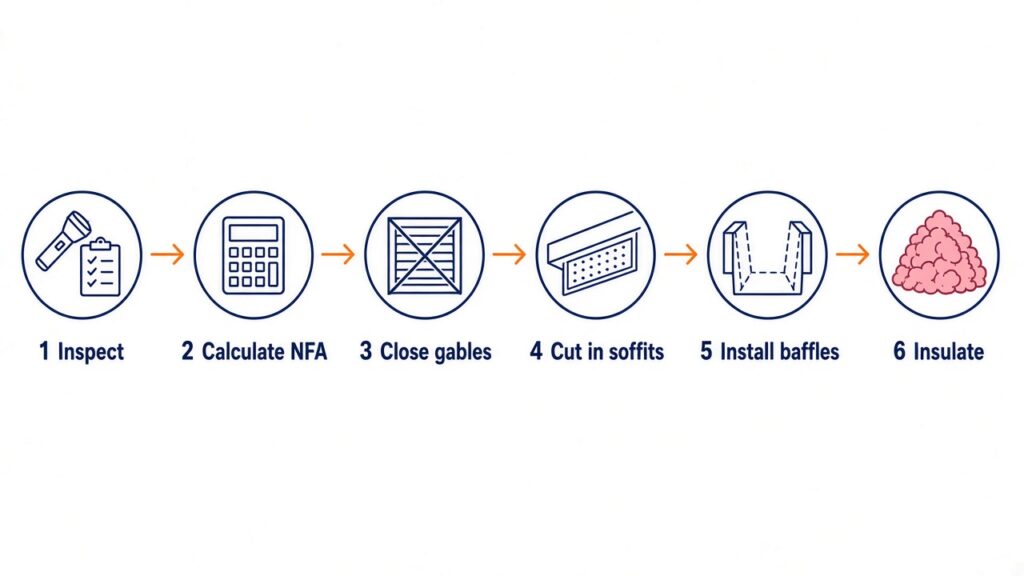
On a typical job we inspect, air seal the attic floor, calculate the net free area, close short-circuiting gable vents, cut in soffit intake, install baffles, and install the new insulation with the soffit channels kept open. If the existing insulation is clean, dry, and even, a full removal may not be necessary. We will tell you after we see the attic.
A bathroom fan that blows shower moisture into the attic is a related problem we correct in the same visit. Virginia code requires that exhaust to go directly outdoors. We explain it in Is Your Bathroom Fan Venting Into the Attic?.
For a sense of what drives the scope of an insulation job, see what affects insulation cost in Virginia Beach in our Homeowner Resource Center.
When a ridge vent or attic fan is part of the plan
Our crew handles soffit cut-ins, gable closures, baffles, air sealing, and the airflow calculation. We do not cut the roof. If the attic needs a new ridge vent or an attic fan, our experienced roofing partner installs that exhaust. The same is true of a dedicated bath roof vent. We check the roof ventilation; we do not repair or replace roofs, and we do not install gutters.
A fan is not the first answer when soffits are blocked or gable vents are short-circuiting the ridge. The first fix is a balanced passive path. We only bring in a fan when that is the right exhaust for the house, and we still balance the intake to match.
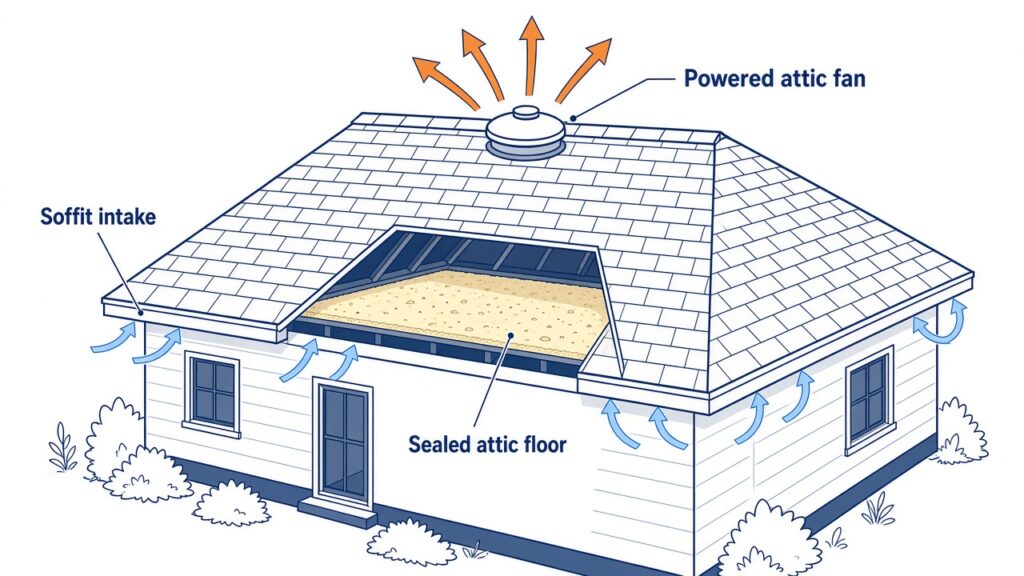
Hip roofs and other houses with little or no ridge often need that fan. Our experienced roofing partner installs it near the peak, and our crew does the soffit intake, baffles, air sealing, and insulation. We do not install the fan ourselves. See hip roofs and homes without ridge or gable vents and Attic Fan Installation in Virginia Beach: When It Belongs in a Whole-Attic Job. The anatomy of a roof and attic shows which layers we handle and which the roofing partner handles.
If the plan is closed-cell Natural Polymers spray foam on the underside of the roof deck, the attic is an unvented assembly, and existing vents are typically sealed. Blown-in or batt insulation on the attic floor still needs a balanced, vented attic. We will tell you which assembly fits the house.
Frequently asked questions
What is proper attic ventilation?
For a vented attic, soffit intake low on the roof and one type of exhaust high at the ridge or another high vent, with air traveling the length of the attic instead of shortcutting through a nearby gable.
Do you cut in soffit vents and close gable vents?
Yes. Our in-house crew cuts in soffit intake when it is missing or too small, and closes gable vents that are short-circuiting a ridge vent, as part of the insulation job. That is ventilation work, not soffit replacement and not roof work.
If I need a ridge vent or an attic fan, do you install that?
We do not cut the roof. Our crew handles soffit cut-ins, gable closures, baffles, and the airflow calculation. Our experienced roofing partner installs a new ridge vent or attic fan when one is needed.
My house has a hip roof with almost no ridge. How should the attic be vented?
Start with the soffits. If the ridge is too short for a ridge vent, our experienced roofing partner installs a powered attic fan near the peak, and we air seal the attic floor and size the soffit intake to match.
Can a bathroom fan vent into the attic if the attic is well ventilated?
No. Virginia code requires bathroom exhaust to go directly outdoors. Our experienced roofing partner installs a dedicated, dampered roof vent, and we connect your fan to it with insulated flex duct.
Ready to have us look at the attic?
Zhe Industries, LLC, is a locally owned Virginia Class A contractor and the only Owens Corning Certified Energy Expert in Hampton Roads. We serve homeowners throughout Virginia Beach, Chesapeake, and the rest of Hampton Roads. If you want us to look at the attic, use the button above or call 757-759-5466. We will inspect the insulation, the vents, and the airflow, and send a written quote before work begins.