Attic Fan Installation in Virginia Beach: When It Belongs in a Whole-Attic Job
If you have been searching for attic fan installation in Virginia Beach, you probably have a hot upstairs and want a fan put on the roof. That may be part of the answer. It is not the whole job, and it is not a standalone service we sell.
Zhe Industries is an insulation contractor, not a roofing company. We calculate the ventilation the attic needs, air-seal the attic floor, and install the insulation. When a powered attic fan is the right exhaust, our experienced roofing partner installs the fan as part of that whole-attic job. We do not cut the roof, and we do not install attic fans by themselves. If you only want a fan put in and nothing else done in the attic, we are not the right call for that work.
What an Attic Fan Is — and What It Isn't
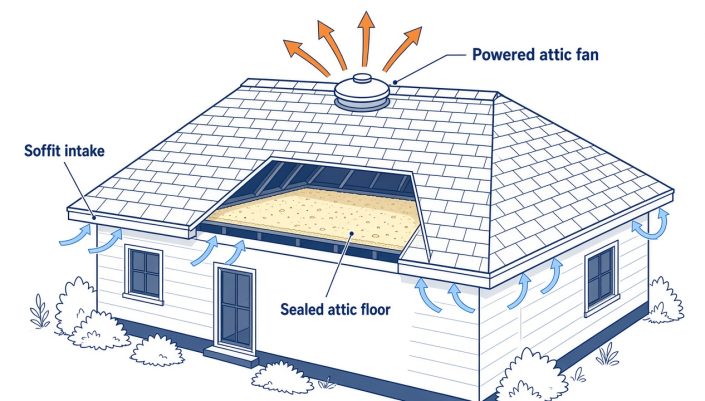
A powered attic fan, sometimes called an attic exhaust fan or a roof ventilation fan, sits near the high point of the roof and pulls hot, humid air out of the attic. Fresh air should enter low, at the soffits, travel the length of the attic, and leave through the fan. Solar and hardwired fans both do this job. A thermostat can run the fan on hot days, and a humidistat can run it when the attic air is damp, which matters in Hampton Roads.
An attic fan is not a whole-house fan. A whole-house fan is mounted in the ceiling and pulls air from the living space into the attic on purpose. An attic fan should pull air from the attic only, not from the rooms below. It is also not a bathroom exhaust fan. A bath fan has to vent outdoors through its own roof cap, not into the attic and not through the attic fan. If a bathroom fan is dumping into your attic, that is a different problem, and we fix it only as part of an attic insulation removal and replacement.
For how intake and exhaust are supposed to work together, see our attic ventilation page.
When Attic Fan Installation Makes Sense
A balanced passive system is still our first choice when the house can support it: clear soffit intake, an air-sealed attic floor, and one type of high exhaust, usually a ridge vent. The Department of Energy and ENERGY STAR do not recommend powered attic fans as an energy-saving upgrade, and we agree with that when a ridge vent can do the job.
Many Hampton Roads homes cannot get there with a ridge vent alone. Hip roofs slope on all four sides and often have little or no ridge at the top, and no gable walls for gable vents. Complex roofs with a lot of hips and valleys have the same problem. On those houses there may not be enough ridge length for a ridge vent to provide the exhaust the attic needs. That is when we recommend a roof-mounted powered attic fan, installed near the peak by our experienced roofing partner.
The fan has to be the only exhaust. Old box vents, turbines, or short ridge sections should be removed or capped, and any gable vents should be closed, or the fan will pull air through the nearest opening instead of from the soffits. The fan also has to be sized to the attic, and the soffit intake has to match it. We walk through the hip-roof layout, the diagram, and the sizing rules on our attic ventilation page, in Hip roofs and homes without ridge or gable vents.
When an Attic Fan Is the Wrong Fix
A fan is not a shortcut around a blocked or unbalanced attic.
If the soffits are stuffed with insulation, or gable vents are short-circuiting a ridge vent, the first fix is the passive path: open the intake, close the competing exhaust, and air-seal the attic floor. Adding a fan on top of that mess can make the attic worse, not better.
If the attic floor is leaky, a running fan can depressurize the attic and pull conditioned air out of the house through gaps around recessed lights, the attic hatch, plumbing and wiring holes, and top plates. ENERGY STAR and the Department of Energy warn that this wastes air conditioning. In a home with a natural-draft gas water heater or furnace, it can also pull exhaust gases back into the living space. That is why a fan is never a stand-alone fix.
If the plan is closed-cell Natural Polymers spray foam on the underside of the roof deck, the attic is designed as an unvented assembly. Existing vents are typically sealed, and an attic fan is not part of that system. We install only closed-cell Natural Polymers, and only when that assembly is the right one for the house. We will not mix roof-deck foam with a vented, blown-in attic floor.
For the comfort problems a poorly vented attic causes in summer, see The Role of Roof Ventilation in Keeping Your Home Comfortable. For the basics of why ventilation matters, see The Importance of Proper Attic Ventilation.
Attic Fan Insulation, Air Sealing, and Covers
Homeowners often ask about attic fan insulation, insulating around an attic fan, or an attic fan cover. Those phrases usually point to the same attic details that make a fan safe to run.
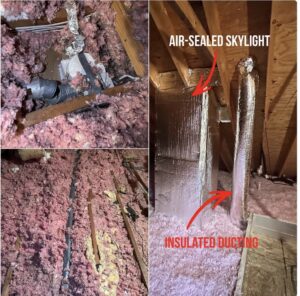
A roof-mounted attic fan lives on the roof, not in the insulation on the attic floor. You should not bury the fan, and you should not pile loose-fill up into the soffits to “insulate around it.” What belongs around the fan is clear intake at the eaves, baffles that keep new insulation from blocking those channels, and a well-sealed, well-insulated attic floor underneath. That insulation and air sealing are the work our crew does. They are what keep the fan from pulling cooled or heated air out of the rooms below.
An “attic fan cover” often refers to a winter cover for a whole-house fan, which is a different appliance. A roof-mounted attic fan is not something you cover with a blanket of insulation in January. It may have a damper, and it should be controlled so it is not running when you do not want it to, but the important winter work is still the air-sealed, insulated ceiling plane and clear soffit intake.
If an old fan is being removed and not replaced, that roof opening has to be finished correctly by the roofing partner. Leaving a hole, or an abandoned fan, in the roof is not an insulation shortcut.
How Our Crew Calculates Attic Ventilation
Zhe’s crew does all of the ventilation calculations as part of the insulation remodel. We do not size a fan, or a ridge vent, from a generic chart. We measure the attic in front of us, add up the vents that will actually remain, and then decide what exhaust, air sealing, baffles, and insulation the house needs.
The starting point is the code. The 2021 International Residential Code, Section R806.2 — which Virginia adopted in the 2021 Virginia Residential Code — says: “The minimum net free ventilating area shall be 1/150 of the area of the vented space.” The same section allows that minimum to be “1/300 of the vented space” when both listed conditions are met. The condition that matters in Hampton Roads is the intake-and-exhaust balance: not less than 40 percent and not more than 50 percent of the required ventilating area has to be high in the attic, within three feet of the ridge or highest point, measured vertically, or as close as the framing allows, and the balance has to be in the bottom one-third, typically the soffits. In Climate Zones 6, 7, and 8, the exception also requires a Class I or II vapor retarder on the warm-in-winter side of the ceiling. Hampton Roads is in Climate Zone 3A, so that vapor-retarder condition is not what drives the math here.
Here is a simple example, not a quote for your house. Take a 1,500-square-foot attic. At the 1/150 rate, that attic needs 10 square feet of net free area, or 1,440 square inches. If the intake and exhaust are split the way the 1/300 exception describes, the same attic needs 5 square feet, or 720 square inches, with about 2 to 2½ square feet high at the exhaust and the rest low at the soffits. Your attic will be different. We run the numbers from its floor area and from the vents that will stay open.
Intake and exhaust have to be planned as a pair. A balanced attic pulls roughly half of its ventilation from low intake at the soffits and half from high exhaust. Exhaust without enough intake cannot do its job. Extra exhaust, or a fan on top of blocked soffits, can pull air from the living space if the attic floor is leaky. When we calculate, we plan that split on purpose.
Net free area, or NFA, is the actual open area of a vent after the screen or slats are subtracted, not the size of the hole in the soffit or the length of the ridge. Each manufacturer publishes an NFA rating for its soffit vents, ridge vents, and gable vents. We add up the NFA of the intake and the exhaust that will remain after the job. Gable vents that would short-circuit a ridge vent or a fan are closed, so they do not count as useful ventilation. If the remaining ridge cannot supply the high exhaust the calculation calls for — common on hip roofs with little ridge — that is when a powered attic fan may belong in the plan. The soffit intake still has to match it.
Those results decide the rest of the scope. They tell us whether a balanced passive system will work, or whether an attic fan is the right exhaust. They also tell us what has to happen before any fan is installed: air-seal the attic floor so the system does not pull conditioned air from the rooms below; install baffles so the new insulation does not block the soffit intake; and install the insulation to the depth the attic needs, keeping those intake channels open. The fan, if it is needed, is installed by our experienced roofing partner as part of that same job.
How Zhe Handles Attic Fan Installation
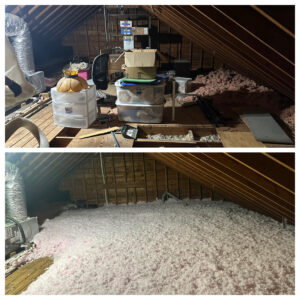
Attic fan installation, when we are involved, is part of a whole-attic insulation job, usually during attic insulation removal and replacement.
Here is how the work is split:
- Zhe’s crew inspects the attic with diagnostic tools, calculates the intake and exhaust the space needs, air-seals the attic floor, cuts in soffit intake where it is missing or too small, installs baffles, closes gable vents that would short-circuit the fan, and installs the insulation.
- Our experienced roofing partner installs the roof-mounted fan and handles any roof cutting, capping, or removal of old roof vents. Zhe does not do that roof work.
We will tell you if a fan is the right exhaust for your house, and we will tell you if it is not. If a ridge vent will do the job, that is the path we recommend. If you are only shopping for someone to mount a fan and leave the attic as-is, that is not our service.
Frequently Asked Questions
Do you install attic fans in Virginia Beach? Our experienced roofing partner installs the fan. Zhe Industries handles the attic work that has to go with it: ventilation calculations, air sealing, soffit intake, baffles, and insulation. We do not offer standalone attic fan installation.
Will an attic fan pull air conditioning out of my house? It can, if the attic floor is leaky or the soffit intake is too small. The fan then pulls air from the rooms below instead of from the eaves. That is why we air-seal the attic floor and size the intake to the fan before a fan goes in.
When does an attic fan make sense instead of a ridge vent? When the roof does not have enough ridge for a ridge vent to provide the exhaust the attic needs, which is common on hip roofs and on complex roofs with many hips and valleys. When a ridge vent will work, it is still our first choice.
How does Zhe calculate attic ventilation? Our crew does the ventilation calculations as part of the insulation remodel, not as a standalone fan quote. We start with the minimum net free area in the 2021 IRC and Virginia Residential Code Section R806.2 — 1/150 of the attic floor area, or 1/300 when intake and exhaust are balanced the way the code describes — then we add up the net free area of the soffit, ridge, and gable vents that will remain. Those numbers tell us whether an attic fan fits, what air sealing has to happen first, and how baffles and insulation depth are set so the intake stays open.
What does “attic fan insulation” mean, and do I need a cover? For a roof-mounted attic fan, it means air-sealing and insulating the attic floor and keeping insulation from blocking the soffit intake, not burying the fan. A winter “attic fan cover” is usually for a whole-house fan, which is a different device. We do not treat a roof-mounted fan as something you cover with insulation.
Is an attic fan the same as a whole-house fan or a bathroom fan? No. An attic fan exhausts attic air at the roof. A whole-house fan pulls living-space air into the attic. A bathroom fan has to vent shower moisture directly outdoors through its own roof cap, not into the attic.
If I get spray foam, do I still need an attic fan? Not if the foam is closed-cell Natural Polymers applied to the underside of the roof deck. That is an unvented attic, and existing vents are typically sealed. Blown-in or batt insulation on the attic floor still needs a balanced vented attic, which may use a fan when a ridge vent cannot do the job.
Trusted Local Experts Are Here to Help
If your Virginia Beach or Hampton Roads attic is running hot, the question is not only “who will install an attic fan?” It is whether the attic needs a fan at all, and whether the floor is sealed and insulated so that fan does not pull conditioned air out of the house.
Zhe Industries will evaluate the attic, do the ventilation calculations, and handle the air sealing and insulation. When a fan belongs in the plan, our experienced roofing partner installs it as part of that job. We do not sell standalone fan installation. If that whole-attic scope is what you need, contact us for a free estimate.
Zhe Industries is Licensed Beyond Insulation™ and an Owens Corning® Certified Energy Expert®. As a Class A contractor, we work throughout Hampton Roads, including Virginia Beach, Norfolk, Chesapeake, and Williamsburg.