
When people talk about “the roof,” they often mean the shingles you can see from the street. The part that actually protects your comfort, your energy bills, and the wood under those shingles is the whole roof-and-attic system: the decking, the ventilation path, the baffles, the air seal, and the insulation. Understanding how those layers work together helps you spot problems early and decide what to fix, whether you are planning an insulation upgrade or trying to cool a hot upstairs in summer.
This is not a guide to buying a new roof. Zhe Industries does not repair or replace roofs. We work from the attic side of that system, and when a new ridge vent, attic fan, or bath roof vent is needed, our experienced roofing partner installs it.
What Are the Layers of a Roof and Attic?
A typical Hampton Roads roof and attic is built in layers, each with a job. Starting from the outside and working in:
Roof covering. This is the weather surface you see from the street, most often asphalt shingles in this area, though some homes have metal or other coverings. It sheds rain and sun. We don’t install or sell roofing, but the covering only lasts as long as the attic below it stays reasonably cool and dry.
Underlayment. This layer sits on top of the roof deck, under the shingles. It is typically felt or a synthetic membrane, and it is a second barrier against water if wind-driven rain gets under the covering.
Flashing. Thin metal at roof valleys, chimneys, plumbing stacks, and other penetrations directs water away from those openings so it doesn’t leak into the attic or the rooms below.
Roof decking. This is the structural skin of the roof, usually plywood or oriented strand board (OSB). From the yard you never see it. From the attic, you are looking at its underside. The decking carries the roof covering, and it is also the first wood surface that attic heat and moisture reach. Dark staining, rusty nail tips, or damp sheathing on the underside of the deck are signs the attic is not staying dry.
Ventilation (intake and exhaust). In a vented attic, outside air should enter low, usually at the soffits, travel through the attic, and leave high, usually at a ridge vent. That airflow carries heat and moisture out before they soak the decking and the insulation. The system only works when intake and exhaust are in balance, roughly half of the vent area low and half high, and when the air can travel the length of the attic instead of taking a shortcut near the peak. Our in-house crew cuts soffit intake where it is missing or too small, and closes gable vents that are short-circuiting a ridge vent. When a new ridge vent, or a powered attic fan on a hip roof that has no ridge, is the right exhaust, our experienced roofing partner installs it. Learn more on our attic ventilation page.
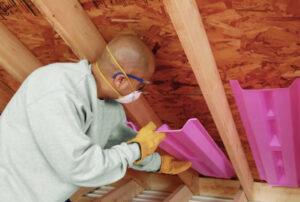
Baffles. Baffles, sometimes called rafter vents, are channels fastened to the underside of the decking at the eaves. They keep a clear air path from the soffit vents up into the attic so loose-fill insulation can’t block the intake. Without them, new insulation often gets blown into the soffits and chokes the system. We install baffles as part of our attic work, before the insulation goes in.
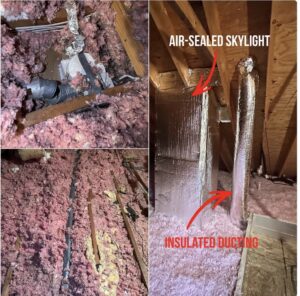
Air sealing. The attic floor, which is usually the ceiling of the rooms below, is full of small gaps: around light fixtures, plumbing and electrical penetrations, the attic hatch, and bath fan housings. Those gaps let conditioned air leak into the attic, which wastes energy and can add moisture under the roof. Air sealing those bypasses is what makes the insulation actually perform. See our air sealing page.
Insulation. In a vented attic, insulation sits on the attic floor. Its job is to slow heat flow so your home stays more even and your HVAC doesn’t work as hard. Insulation only does that job when it is dry, at the right depth, and not covering up a ventilation or moisture problem.
How These Layers Work Together
Think of the roof covering, underlayment, flashing, and decking as the weather shell, and the ventilation, baffles, air seal, and insulation as the attic system that keeps that shell, and the rooms below, in good shape.
- If soffit intake is blocked or baffles are missing, exhaust vents at the ridge can’t pull air through the attic. Heat and moisture sit under the deck.
- If a ridge vent is used together with open gable vents, the ridge often pulls air from the nearby gable openings instead of from the soffits. The air takes a short path at the peak and skips the rest of the attic.
- If the attic floor isn’t air sealed, the ventilation system can pull conditioned air out of the house, and moist indoor air can condense on cool roof framing.
- If insulation is added on top of a disconnected bathroom fan duct, the shower moisture gets released under the new insulation, and the problem gets worse, not better. We wrote about that in Is Your Bathroom Fan Venting Into the Attic?.
- If insulation is wet or matted, it loses much of its R-value, no matter how much was installed.
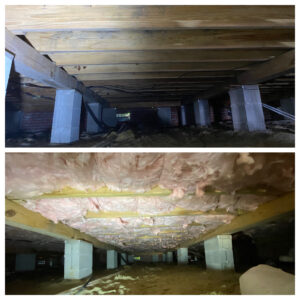
That is why we would rather reset an attic, removing the old insulation, fixing ventilation and air sealing, and then insulating, than just “top off” what’s already there. During an attic insulation removal and replacement, the decking, baffles, soffits, bath fan ducts, and air leaks are all in plain view.
A closed-cell Natural Polymers Ultra-Pure® spray foam application on the underside of the roof deck is a different, unvented assembly. In that case the foam itself is the air seal and the insulation at the roof line, and existing attic vents are typically sealed. Every spray foam job we do includes an ACE Conformance report. If that assembly is the right fit, we will explain it on the inspection. Most of the homes we see, though, are vented attics that need the layers above working together.
What We Do, and What Our Roofing Partner Does
Zhe Industries is an insulation contractor. Our in-house crew:
- Inspects the attic and the ventilation path
- Cuts soffit intake where it is missing or too small
- Closes gable vents that are short-circuiting the system
- Installs baffles
- Air seals the attic floor
- Removes and replaces insulation
- Installs closed-cell Natural Polymers spray foam when that is the right assembly
We do not repair or replace roofs, and we do not install shingles, underlayment, or flashing.
Our experienced roofing partner installs:
- Ridge vents
- Attic fans, including powered fans for hip roofs
- Bath roof vents, when we correct bathroom exhaust venting as part of an attic insulation removal and replacement package
Frequently Asked Questions
Does the anatomy of a roof include the attic? Yes. The shingles, underlayment, flashing, and decking are the weather shell. The ventilation path, baffles, air seal, and insulation are the attic system that keeps that shell, and the rooms below, cooler, drier, and more efficient. Looking at only the shingles misses the layers that usually cause comfort and moisture problems.
Does Zhe Industries repair or replace roofs? No. We do not repair or replace roofs, and we do not install shingles, underlayment, or flashing. Our crew works from the attic: insulation, air sealing, baffles, soffit intake, and gable vent closures. When a new ridge vent, attic fan, or bath roof vent is needed, our experienced roofing partner installs it.
Why does attic ventilation matter for the roof deck? In a vented attic, balanced intake at the soffits and exhaust at the high point carry heat and moisture out before they collect on the underside of the decking. Blocked soffits, missing baffles, or a ridge vent mixed with open gable vents can leave the deck stained, damp, or overheated, which is hard on both the wood and the roof covering above it.
Should I add more insulation without checking the other layers? We don’t recommend a “top-off” until the attic has been inspected. New insulation can block soffit intake, bury a disconnected bath fan duct, and hide moisture on the deck. An attic insulation removal and replacement lets us see those layers, fix ventilation and air sealing, and then insulate.
Trusted Local Experts Are Here to Help
If your upstairs runs hot, your attic looks stained or musty, or you are due for an insulation upgrade, start with the attic system, not a new layer of insulation on top of a problem. The experts at Zhe Industries will inspect the decking, ventilation, baffles, air seal, and insulation, and we’ll tell you what the house actually needs.
Zhe Industries is Licensed Beyond Insulation™ and an Owens Corning® Certified Energy Expert®. As a Class A Contractor, we specialize in creating comfortable, energy-efficient homes throughout Hampton Roads, including Virginia Beach, Norfolk, Chesapeake, and Williamsburg. Contact us for a free estimate on attic ventilation or attic insulation removal and replacement.