If your home has drafts, cold rooms, or rising energy bills, insulation alone may not be the problem. Many homes suffer from air washing (wind washing)—moving air that pushes insulation out of place and dramatically reduces performance. In many homes, air washing (also known as wind washing) is the hidden problem that makes insulation underperform—even when there appears to be “enough” insulation in the attic
What Is Air Washing (Wind Washing)?
Air washing occurs when wind or pressure-driven airflow moves through attic or wall cavities and shifts loose-fill insulation, leaving gaps and thin spots. As simple as opening or shutting an interior door within your home can create enough pressure to displace insulation when air sealing hasn’t been done.
Result: The insulation’s R-value (insulating power) drops significantly — leading to comfort issues, energy loss, and potential moisture concerns.
Common Warning Signs
- Drafty rooms, especially upstairs
- Hot or cold spots that never even out
- Uneven temperatures from room to room
- Higher utility bills than expected
- HVAC runs longer and/or more frequently
- Thermostat doesn’t reach desired temperature
- Insulation near attic edges looks uneven or “blown back”
- Possible moisture issues from uncontrolled air movement
Why Adding More Insulation Often Doesn’t Solve It
Insulation works best when it stays in place and air isn’t flowing through it.
If air is moving through your attic and wall cavities, it can:
- Continue to push insulation out of place
- Carry heat and humidity through areas that should be sealed
- Reduce the real-world performance of even “high R-value” insulation
The Proper Fix: Remove, Air Seal, Then Insulate
At Zhe Industries, LLC, we address the root cause—air movement—before installing or correcting insulation.
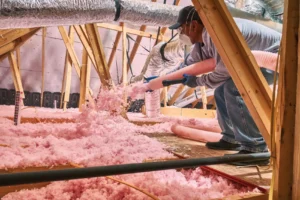
Proper air sealing can only be achieved with full access to the attic floor to seal key leakage points, which often requires removing insulation to find hidden air penetration areas. Loose-fill insulation (and even batts) can hide critical gaps and penetrations where air movement originates. If those areas are not exposed, they cannot be sealed thoroughly, and wind washing can continue to undermine performance.
To seal the right way, insulation is completely vacuumed out to expose:
- Top plates along eaves, interior top plates, and attic-to-wall transition areas
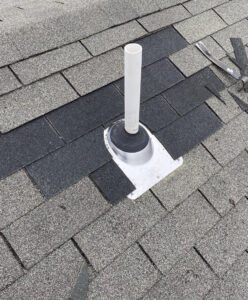
- Plumbing stacks, wiring penetrations, and junction points
- Open chases around ductwork, bath fans, and framing gaps
- Dust registers and face plates/HVAC boots
- Attic access hatches and access framing
- Soffit, knee wall, and other bypass connections
- Any penetrations as big as a hairline crack will be sealed
Then we:
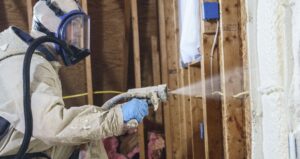
- Apply ProPink ComfortSeal ™where needed, our standard air sealing service. Or we can apply an upgraded option – Ultra Pure Spray Foam Insulation. The Ultimate Air Sealing Technology with Natural Polymers™
- After air sealing is complete we install Owens Corning ProPink L77 insulation for full, consistent coverage of R49 value.
Why You Must Air Seal Before Adding or Replacing Insulation
Here is the key point: If you add insulation without air sealing first, airflow can still move through it and around it—so you’re paying for insulation that cannot perform at its rated R-value.
Air sealing addresses the root cause by blocking the pathways that allow air movement. Once those leaks are sealed:
- Insulation stays where it belongs
- R-value performance becomes consistent across the attic
- Comfort improves noticeably
- HVAC cycles less often
- Moisture migration is reduced
What You Gain
- Fewer drafts and noticeably improved comfort
- Consistent insulation coverage for better real-world R-value
- Reduced HVAC run time and energy waste
- More stable indoor temperatures
- Reduced risk of moisture movement into cavities
- Healthier, indoor air quality!
Our Comprehensive Process
- Assessment – Identify air leaks and insulation displacement
- Access Prep – Vacuum out and remove all contaminated insulation
- Air Sealing – Seal bypasses thoroughly with foam/air sealant
- Insulation – Install new insulation for complete, even coverage
- Final Check – Confirm coverage, depth consistency, and reduced leakage
Schedule Your Air Sealing & Insulation Assessment
If you want insulation that performs the way it’s supposed to, start with air sealing.
Have Questions? Call Today! Call us 757-759-5466